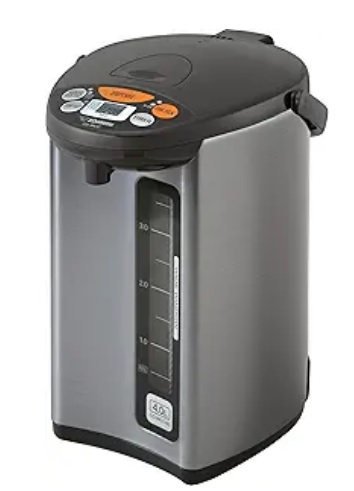
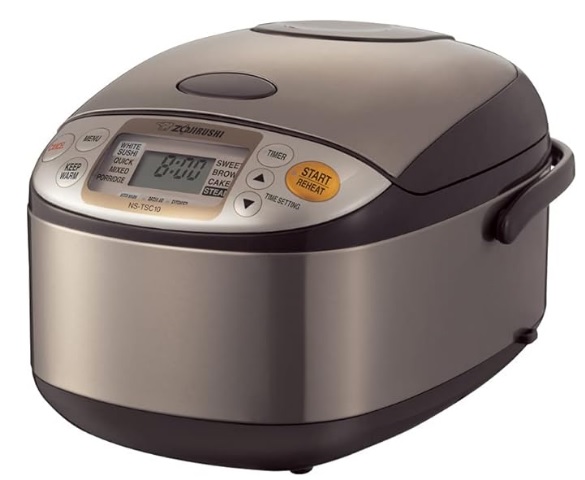
| Water warmers and
rice cookers |
| |
| Often in winter or on rainy days we have
to be able to serve a lot of warm tea before students start
class, during the three |
| beverage breaks and after class. This
means tea has to start steeping minutes before and that we might
need to change |
| what has been prepared in favor of what
a student wants at that particular time. For example, a student
might typically want rooibos, but, due to seemingly
unpredictable and often invisible factors, decides decaffeinated
green tea is the beverage |
| of the moment. The best tactic so far
has been to prepare heated water in advance and save the
microwave with its limited |
| capacity as a final resort. Note that
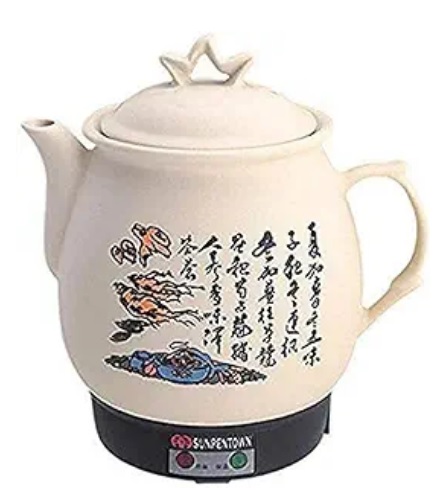
some Traditional Chinese Medicine prescriptions call for heating
or even boiling herbs - |
| we suggest a check with the prescribing
physician: a separate specialty kettle (below left) is probably
best. |
| For making 13 Treasures porridge
(congee) we have explored both rice cookers and simply large
stovetop pots. Your results |
| may vary. To be considered are the
chances of burning the porridge or at least having some porridge
stick to the pot or |
|
cooker, overall cooking speed (throughput) and how long it takes
to clean and set the vessel for the next batch. We currently |
|
favor a large stovetop pot with a well-fitted lid - this
requires setting the burner temperature to low and using a timer
to stir |
|
every 20 minutes. Be careful to add water as needed - DO NOT
overfill (so perhaps an inch below the lowest edge of the |
|
lid) lest a very sticky mess result. Note that we use two
large rice cookers - you probably just need one smaller rice
cooker |
|
for home preparation. Make sure that there is a congee setting.
Check for a no-stick liner and a detachable [washable] lid.
|
|
|
|
|